Aus Squad Leader
CORREGIDOR: THE ROCK
CORREGIDOR: THE ROCK
Couldn't load pickup availability
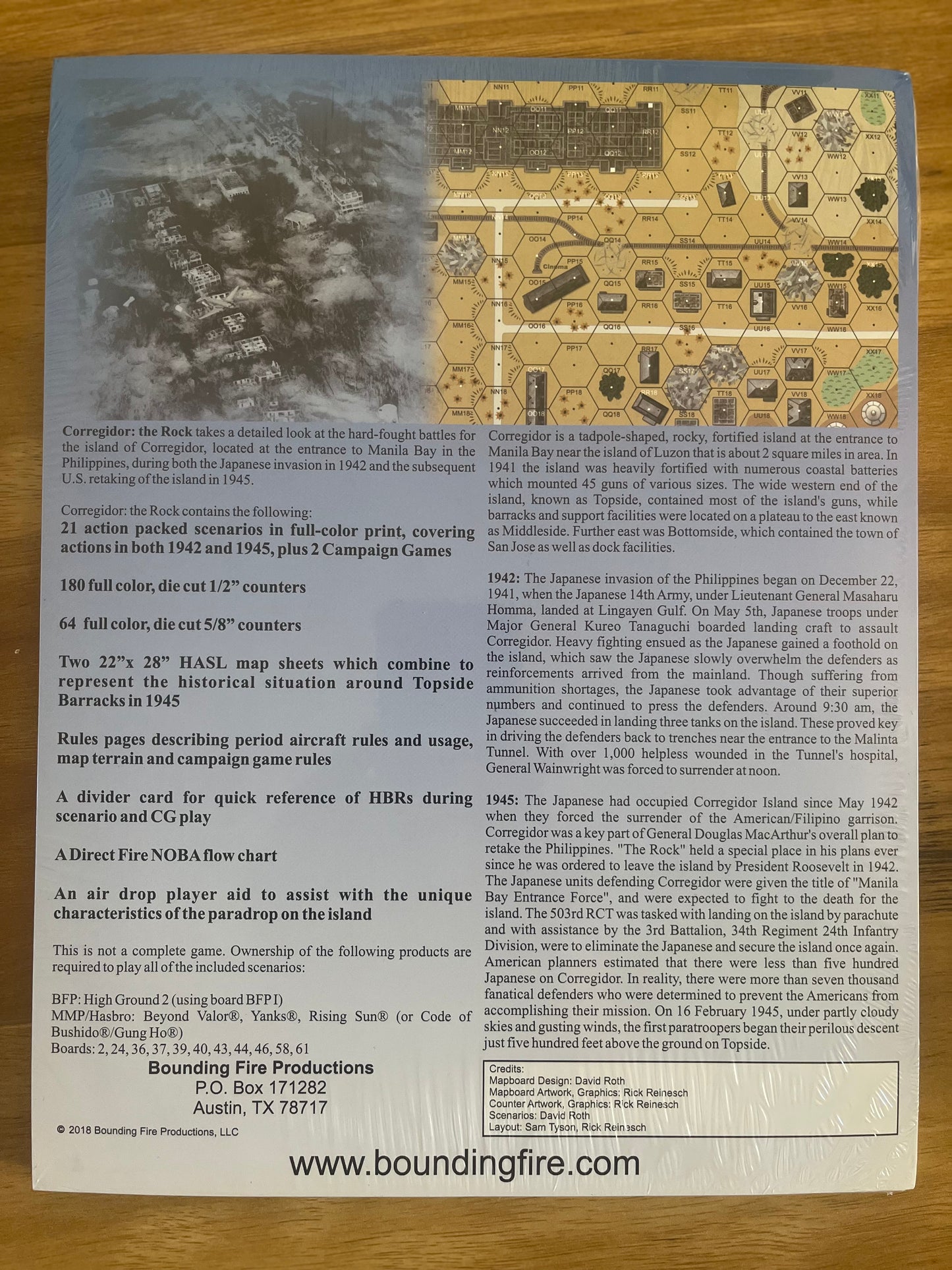
Historical map (composed of 2 x 22" x 28" sections), 1 sheet of 1/2" and 5/8" die-cut counters (244 counters total), 21 scenarios on cardstock, 2 campaign games, 4 sets charts/tables, 36 pages of rules.
Corregidor: The Rock (CtR) is a historical module from Bounding Fire Productions released in late 2018 that depicts fighting on the island of Corregidor situated in Manila Bay in the Philippines during World War II. Corregidor is a small but strategically significant island that dominates Manila Bay–and thus access to Manila. In 1941-42, it also served as the headquarters of MacArthur and his forces (USAFFE) until the Japanese took the island in May 1942 following the fall of Bataan in a costly amphibious invasion. In February 1945, as MacArthur invaded Luzon, the main island of the Philippines, he also retook Corregidor with a combined air landing and amphibious assault.
Corregidor is often described as a “tadpole,” because of its unique shape. The “head” of the tadpole, the highest and largest area of the island, on its westward end, is known as Topside. In the middle of the island, at its waist, are Bottomside, where the port areas are, and Malinta Hill, a tall hill containing a large tunnel system. The long tail of the island extends to the east. In 1942, the Japanese landed on the eastern end of the island and fought their way west to Malinta Hill, at which point the Americans surrendered. There was no fighting on Topside. In contrast, in 1945 the Americans decided to retake the island via a somewhat risky low-level daylight air assault on Topside, supplemented by an amphibious landing on Bottomside. Most of the fighting thus occurred in the western and central areas of Corregidor, with only mopping up occurring in the east.
In both 1942 and 1945 the defenders greatly outnumbered the attackers, but this is rather misleading, because in both cases the majority of military personnel on Corregidor were not front line troops. In 1942, most of the 13,000 Americans and Filipinos on Corregidor were artillery troops (coastal and anti-aircraft) or rear area personnel. There was only one real fighting unit on the island–the 4th Marine Regiment. Similarly, in 1945 most of the 7,000 Japanese personnel on Corregidor were naval personnel (commanded by an IJN captain) organized into provisional units; like their counterparts in Manila, they were well-armed but not trained at all as infantry, except for a contingent of naval landing troops. They would die rather than surrender, but did not have the tactical ability to take that many Americans with them. To this serious liability can be added the fact that, due to several developments early in the battle, the Japanese forces were left without communications and senior leadership, rendering their efforts even more uncoordinated and ineffective. The Americans in 1945 suffered only a quarter of the fatal casualties in retaking Corregidor that the Japanese did in capturing it in 1942, despite the risky airdrop.
CtR, designed by David Roth with graphics from Rick Reinesch, nominally simulates both of these battles, although in reality the product focuses almost its entire effort on the 1945 battle. The historical map, however, covers only a fraction of the island–indeed, just looking at the map one would have no real idea that it even depicted an island. CtR’s historical map features only the central part of Topside, where the initial airdrop took place in 1945. No 1942 scenarios are set on the map, as no fighting took place there in 1942.
This is where the unusual nature of CtR becomes apparent. It is not a historical module in the same vein as Red Factories or Festung Budapest, where all scenarios and campaign games use the included historical map(s). Rather, it is more like Operation Watchtower, in that it features both historical map scenarios and geoboard scenarios, but with far more of the latter than the former. In fact, only 7 of the 21 scenarios of CtR actually use the included historical map. The other 14 scenarios all use geoboards only. This may legitimately disappoint some ASLers who like their historical modules to focus on historical maps. Moreover, CtR’s back-of-the-product marketing language is not explicit about this fact; only careful reading of the “fine print” will allow players to realize that at least some CtR scenarios are geoboard scenarios. However, the marketing language on Bounding Fire Production’s website, at least, is much more explicit about the product’s nature.
Despite the large number of geoboard scenarios, the centerpiece of Corregidor: The Rock is still its historical map. This map, depicting the area of Topside centered around Topside Barracks, comes in two 22″ x 28″ sections, each folded into 8 small squares printed on what seems to be reasonably thick paper with a semi-gloss finish.
The artwork of the CtR maps is impressive, starting with the palette, which paints the 6 elevation levels of this section of Topside in pleasing hues of green tan and brown, with level 0 being a sort of muted lime green. The nonstandard palette really works for this map, creating a nice set of tones but still being perfectly functional, with all levels easily distinguishable from each other. It’s quite attractive. Added to that is an impressive level of detail work especially on the various buildings and batteries, which are rendered in minute detail, even down to their (inoperative) guns. Most of the buildings are roofless, thanks to the extended aerial and naval bombardment that preceded the 1945 invasion, while rubble, debris and shellholes dot the map. Brush–perhaps the most dominant natural terrain feature–is everywhere, while little splotches of jungle appear here and there. The inoperative rail system used to bring shells to the various batteries is also present, though largely for aesthetic reasons rather than because of any practical effects. A great many buildings–the radio station, the NCO club (in ruins), the cinema, and others–are labeled, making the place seem very real rather than abstract.
CtR also comes with a single countersheet containing both 1/2″ and 5/8″ counters. Most of these are markers, including around 115 or so just for the campaign game (perimeter markers, CVP tracking markers, weather markers, etc.). There are also a handful of American 7-4-7 squads and SW, as well as the same for Japanese 4-4-8 squads and infantry crews, plus some extra Japanese concealment markers. There are also 12 “historical” American aircraft counters, a few markers for NOBA direct fire (see below), and some terrain counters (Open Ground and Debris). The Japanese also get two captured Stuart tanks (who seemingly get the HE ammo and machine guns they did not have in 1942). As is typical with Bounding Fire counters of this era, they are nicely die-cut with good graphics. No complaints here.
One of the more exciting rules provides for NOBA Direct Fire. That’s right–naval guns firing directly at targets on the map. These can attack specific locations, with “bonus” results against an adjacent location. Even though it’s from an off-map vessel, a player can easily imagine a 5″ naval gun zeroing in on Japanese huddled in a building. There are also extensive air drop rules, because the air drop on Corregidor was different in several respects from typical World War II air drops, as well as rules for ground attack aircraft. These pages also include “Chapter H”-style details for the individual aircraft types.
The remaining rules are for the two included campaign games, particularly the second one, which is essentially a Red Barricades-style campaign game.
The first campaign game, CGI (The Rock Force Assault), is a linked-scenario campaign game. To play this campaign game, players have to play the 7 scenarios of CtR that take place on the historical map. Victory in a scenario will give a player from 1-4 “points,” depending on the scenario. Players may also accrue points for inflicting more CVP on their opponent than vice versa (1 per scenario). Thus there are a total of 22 points in contention, which allows for a tie. In such a case, there is a somewhat clumsy rule mandating that players choose a 1942 geoboard scenario to play. It would have been smoother simply to add another point to one of the 7 scenarios.
The second campaign game, CGII (Assault on Fortress Corregidor) is a traditional campaign game with 10 campaign game dates (one per day for February 16-25, 1945) that starts with the American airdrop on Topside. Neither side can choose their initial OB (largely for balance reasons; the Japanese can purchase fortifications) but they can choose reinforcement groups. To win, the Americans must amass at least 200 more CVP and 50 more VP than the Japanese. Regular VP are won primarily by controlling or eliminating various batteries, buildings, fortifications, and so forth.
The Japanese can purchase companies of 4-4-8 squads (up to 9), 4-4-7 squads (up to 3) and 3-4-7/3-3-6 squads (up to three), as well as machine gun sections, a couple light vehicles, and a wide variety of Guns. Their OBA is limited, but their fortification purchase options include Caves and Underground Explosions (!).
The Americans have mostly 7-4-7 companies, as well as a few 6-6-6 and 6-6-7 (assault engineers). They have several Gun options, as well as vehicle options including Jeeps, Priests, Shermans and halftracks. They also have a wide array artillery and air options.
The campaign game offers the advantage of being 1) a PTO campaign game, which is not very common, 2) a PTO campaign game not featuring the USMC, which is rarer still, and 3) an air drop campaign game, which itself is quite rare in ASL. So it offers an interesting and unique ASL playing experience.
CtR itself comes with 4 cardstock sheets of charts and play aids, all hole-punched in “chapter divider” style. These include standard American and Japanese campaign game force organizers, a two-sided Paradrop Player Aid to help players with the air drops in scenarios and the campaign game, and a one-sided NOBA Direct Fire Player Aid (essentially a flowchart).
Bounding Fire Productions likes to include a lot of scenarios with its products, and Corregidor: The Rock is no exception, with 21 scenarios, although only 3 of these deal with the 1942 Japanese invasion and only 7 utilize the Topside historical map. Unfortunately, no playtesters are given any credit in the CtR rules. BFP has a good reputation for playtesting, so unlike for certain other third party publishers, there is not necessarily any reason to think that these scenarios were not playtested, but it is good standard practice to list and give credit to all people who helped playtest a particular ASL product. It is also the generous thing to do.
(The above commentary is an edited version from the Desperation Morale website)
Share