Aus Squad Leader
Poland in Flames (BFP5)
Poland in Flames (BFP5)
Couldn't load pickup availability
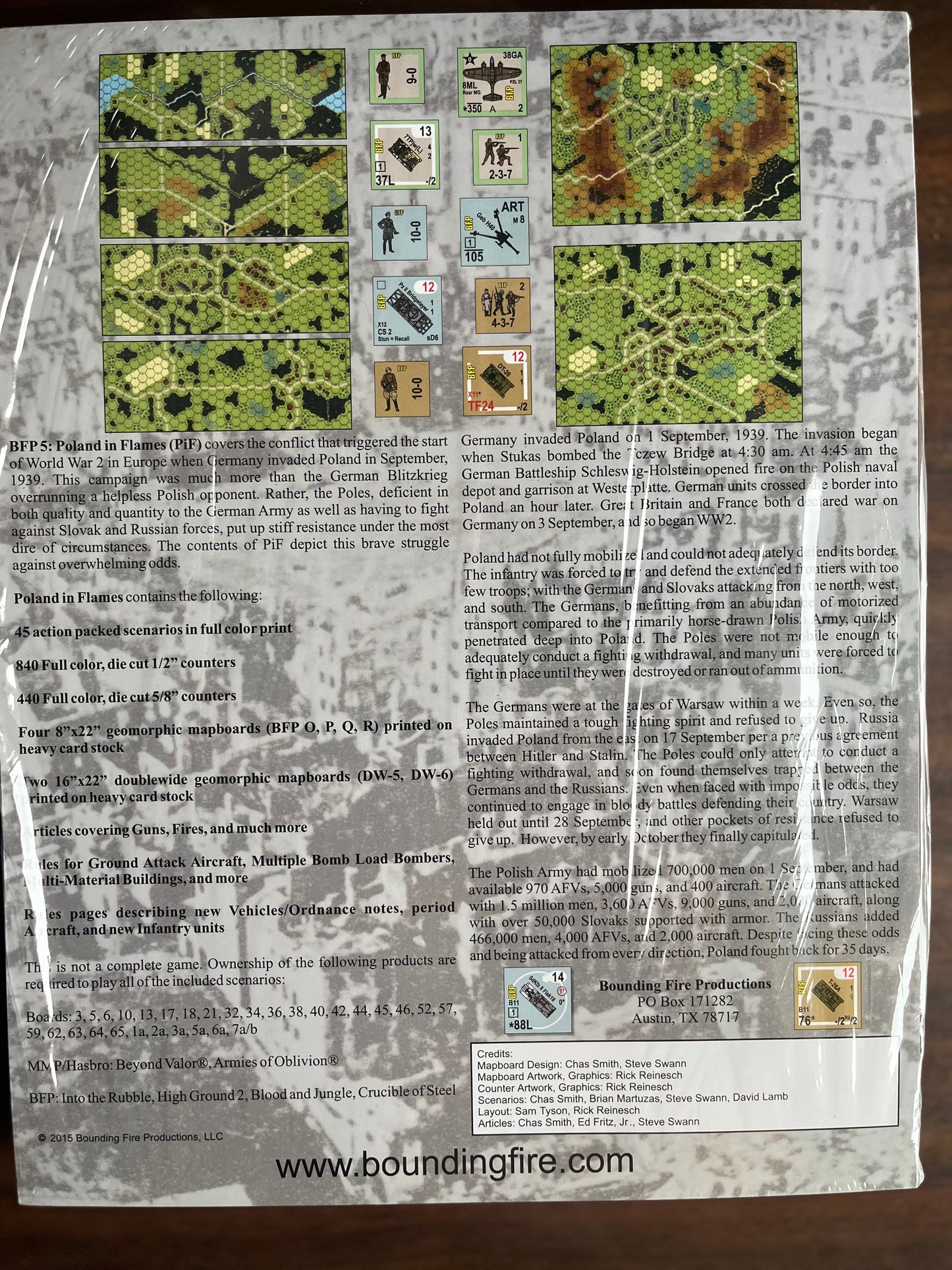
Poland in Flames (PiF) covers the conflict that triggered the start of World War 2 in Europe when Germany invaded Poland in September, 1939. This campaign was much more than the German Blitzkrieg overrunning a helpless Polish opponent. Rather, the polish, deficient in both quality and quantity to the German Army as well as having to fight against Slovak and Russian forces, put up stiff resistance under the most dire of circumstances. The contents of PiF depict this brave struggle against overwhelming odds.
60-page magazine, 8 x 8" x 22" unmounted geoboards (O, P, Q, R, 5a, 5b, 6a, 6b), 1280 die-cut counters, 24 pages of rules. This is a large product that was under development for years, and all 45 of the scenarios have been very thoroughly playtested.
The first geoboard, BFP O, is essentially a stream board, featuring a stream that bisects the entire board lengthwise, with two printed bridges and a ford. Each end of the stream expands out to four-hex “river” width, so that theoretically these boards can be connected to river boards such as 7 or 8, though it seems very unlikely that a designer would do so (and, indeed, none of the four scenarios in PiF that use this geoboard do so). Essentially, it is a handy stream board for scenarios set in rural, open terrain.
BFP P is also pretty open and rural. Instead of a stream, however, it has a long l-shaped gully running across much of its length, as well as a thick patch of woods that spreads out along one lone edge and also spreads sideways across the center of the board. A few low hills and scattered buildings round out the board.
Board BFP Q is what might be called “yet another village board,”, featuring a village that takes up the center 3/4 of the board, consisting mostly of one hex wooden buildings, along with a few multi-hex “multi-material” buildings, which consist of stone on one level and wood on another (a concept that dates back to the early 2000s and first playtest versions of the still-not-out Manila HASL).
BFP R is a rural board with patch woods and orchards, and one medium-sized field. At one end, a handful of wood buildings form a crossroads hamlet.
The boards are all attractive and fully serviceable, with nothing wrong about any of them, but none of them really add much that is novel to the ASL geoboard collection. Things get a bit more interesting with the remaining four geoboards, which are actually two sets of two paired boards–they are not fully geomorphic but designed to be paired with each other.
The first pair is BFP DW-5a and DW-5b (the unnecessary DW stands for “double wide”). Together they form a very interesting terrain configuration: a small village nestled in between two large hills, one of which has two roads running through two saddles in the hills. One of the hills in particular is of a shape that could not be represented by a standard 8″ x 22″ geoboard. Overall, it is a nice addition to the ASL board canon and one of the best components of PiF.
The second board pairing is BFP DW-6a and DW-6b. This pairing represents a somewhat diagonal village of wood buildings. It is not particularly unique or unusual, but the two-board pairing gives the village a width–and thus a dimension–that typical geoboard villages do not have. So it’s nice.
Poland in Flames comes with 24 pages of rules, typically Chapter B and Chapter H style rules. The rules are in full color on hole-punched pages. BFP rules pages are the one area where their products suffer in terms of physical quality. While there is nothing wrong with the color or print quality, the paper used is glossy and very thin–so thin that it immediately starts curling once the product is opened and thin enough that it is vulnerable to folds, creases, rips and tears. ASLers who want to protect their products ought to make color copies or scans of the BFP rules printed on a thicker, higher quality paper than the paper used by BFP.
Six of the pages are taken up by what BFP calls “BFP Terrain Rules (TR).” Essentially, these are the new terrain types and rules introduced over the years by BFP on its own geoboards, organized by product. Thus the rules start off with Into the Rubble terrain types such as storage tanks and Debris, then follow these with Beyond the Beachhead 2 terrain rules, Blood and Jungle terrain rules, High Ground 2 terrain types, and Crucible of Steel terrain rules. Because these rules are organized by module rather than terrain type, one can see how they get ever more unwieldy as more modules are added to the mix. Though called terrain rules, these pages also occasionally have rules for unit types, such as German assault engineers from Crucible of Steel, which adds to the disorganization.
The Poland in Flames rules are added to the end of this compilation, including terrain rules such as Multi-Material Buildings as well as non-terrain rules such as assault engineers and funky new leader types. Note that these rules are added, not integrated, so Hexside Building terrain rules appear on page 3, because of Beyond the Beachhead, on page 5, because of Crucible of Steel, and a third time on page 7, because of Poland in Flames.
The magazine is lengthy–at 60 pages–and printed in full color, so it adds considerably to the cost of the product. However, despite its length, it contains only five articles. The first article is a relatively short set of designers’ notes that focuses exclusively on the boards and counters, with no insight into the rest of the design, such as scenario design, playtesting, and development. It doesn’t really add very much that does not also appear in the rules pages.
The second article is titled “Pyromania: Fire in ASL,” and is a 15 (!) page rules article on fire/blazes/kindling and such stuff in ASL. It’s just a slog to get through and many will fail; it is not just that it is long, but it is densely written, with one paragraph in an extended example of play, for instance, taking 36 lines. Moreover, one must question how much practical, as opposed to theoretical, understanding the author has of the fire rules. For example, in a section on the tactics of kindling, he makes no mention of the trade-offs in time and SMC/MMC usage that a player (typically a defender) must make in order to use kindling. Indeed, at one point, he writes “kindling in L3, N2, N3, and L9 would slow the attacker’s movement,” as if the defender in the average ASL scenario is going to have the spare units and time to try to kindle so many hexes.
The article is useful in one respect: it contains a one-page chart that lists terrain in alphabetical order in one column, and each terrain type’s kindling number and spreading fire number in two more columns. It would be more useful still with the kindling & spreading DRMs and the EC modifiers on it (there’s room), so that players could use that one chart for all their fiery needs. Enterprising ASLers may want to scan this page and make their own such chart.
The author also complains about scenario designers who automatically put “Kindling is NA” in their scenario SSRs, even when that is not needed for game balance purposes, simply because the designers do not like Kindling (this is an example of a grudge rule). Ironically, BFP is one of the worst offenders in this regard: fully 42 of the 45 scenarios in PiF prohibit kindling.
The next article is an even longer (20 pages!) rules articles on guns. It is interesting that, though one of the frequent criticisms of MMP’s stewardship of the ASL Annual and early issues of the ASL Journal was that they relied too much on rules (as opposed to gameplay) articles, BFP is more than doubling down on rules articles. It’s worth noting that this rules article on guns is almost as long as Chapter C itself is (though admittedly Chapter C has smaller print). But it is just not clear that one really needs nearly two pages, for instance, to explain conditional rate of fire, a rule that in the ASLRB takes up one short paragraph and one short example and is really pretty understandable.
The next article is a 3-page historical article on the Polish 10th Cavalry Brigade, one of the Polish Army’s few mechanized units. The third page simply re-summarizes the historical situations of the PiF scenarios involving this unit. The final article is another historical article on the general Polish campaign, focusing on the organization of the Polish armed forces. Neither article is sourced and this brings up the most obvious omission from the magazine: a list of books and other sources used by the various designers and to which players could also turn for more background information on the Polish campaign, a campaign with which many ASLers are not likely to be all that familiar. The lack of a reading list is a somewhat odd gap for the magazine.
The Scenarios
PiF comes with 45 different scenarios–a heaping helping of ASL play value. When BFP first started releasing its monster products with huge numbers of scenarios, Desperation Morale expressed a definite caution and skepticism regarding the playtesting behind the designs–specifically, how such a large number of scenarios could have been adequately playtested. However, BFP’s products have largely proved themselves over time to be solidly playtested and Desperation Morale has no further concerns on that score. This means that the scenarios in PiF all have a pretty good chance of being relatively even and balanced scenarios with few rules issues or errata. Not all third party publishers can say the same of their products.
The scenarios come on glossy cardstock and are printed in color, which includes actual miniature map representations to help players find and align boards (something Desperation Morale wishes MMP would consider doing). The print for the SSRs is small. The scenario cards all have an SSR that reads “See PiF HBR.” There is no explanation of “HBR;” someone on-line suggested it referred to “historical battle rules.” There are no rules so labeled in PiF, but presumably this is a collective reference to all the various rules pages that come bundled in PiF.
Unfortunately, the black ink on the glossy scenario cards is subject to smearing, so players should treat their scenario cards carefully. Players may want to consider doing what Desperation Morale recommends for all ASL scenario cards, which is to scan the cards into a computer and use printouts rather than the original cards.
The scenarios of PiF were overwhelmingly designed by Chas Smith, the driving force behind BFP. However, four scenarios were designed by Brian Martuzas, three by Steve Swann, and two by Dave Lamb. The scenarios bear the typical hallmarks of Bounding Fire Productions scenarios. This means, first of all, that they are large. Indeed, the vast majority of PiF scenarios (33 of 45) are large in size. Another 9 are medium-sized, and 3 could be considered small. They are also vehicle-heavy. In fact, in 17 of the 45 scenarios, at least one side has at least 8 AFVs. One might be forgiven for thinking the Poles had more AFVs than they actually did; 14 of the scenarios of PiF give the Poles at least 5 AFVs. On the plus side, the AFV-centric nature of the module means that there are many tin-can-plinking actions for the sizable number of ASL players who like early war armor actions. Because it is BFP, there are also a lot of fortifications involved, including 12 scenarios with at least 8 fortification counters (and/or mine allotments of any size). Adding to the “heaviness” of the module is OBA; 25% (11 of 45) of the scenarios have at least one module of OBA. Air Support shows up in 6 scenarios. No scenarios take place at Night.
The focus on large, “heavy” scenarios does limit the play value of PiF, of course, as players must have the requisite time needed to play such sizable actions, and many of the scenarios of PiF are unsuitable for tournament settings or “an afternoon of ASL” casual play.
All 45 of the scenarios involve Poles, of course. In three scenarios, the Poles fight the Slovaks and in eight scenarios, the Soviets serve as opponents. The other 34 scenarios feature Germans (including SS) as foes for the Poles.
(most of the above description is an edited version from the Desperation Morale website)
Share